
ESD Bag Selection Guide
How to Choose the Right ESD Bag
To understand how to choose the right ESD bag, start by matching the package to the item and its complete handling path. Antistatic, static-shielding, and moisture-barrier bags do not provide the same protection, and the right choice depends on the item’s sensitivity, whether it will leave an ESD protected area, moisture exposure, packaging method, and any customer or industry requirements.
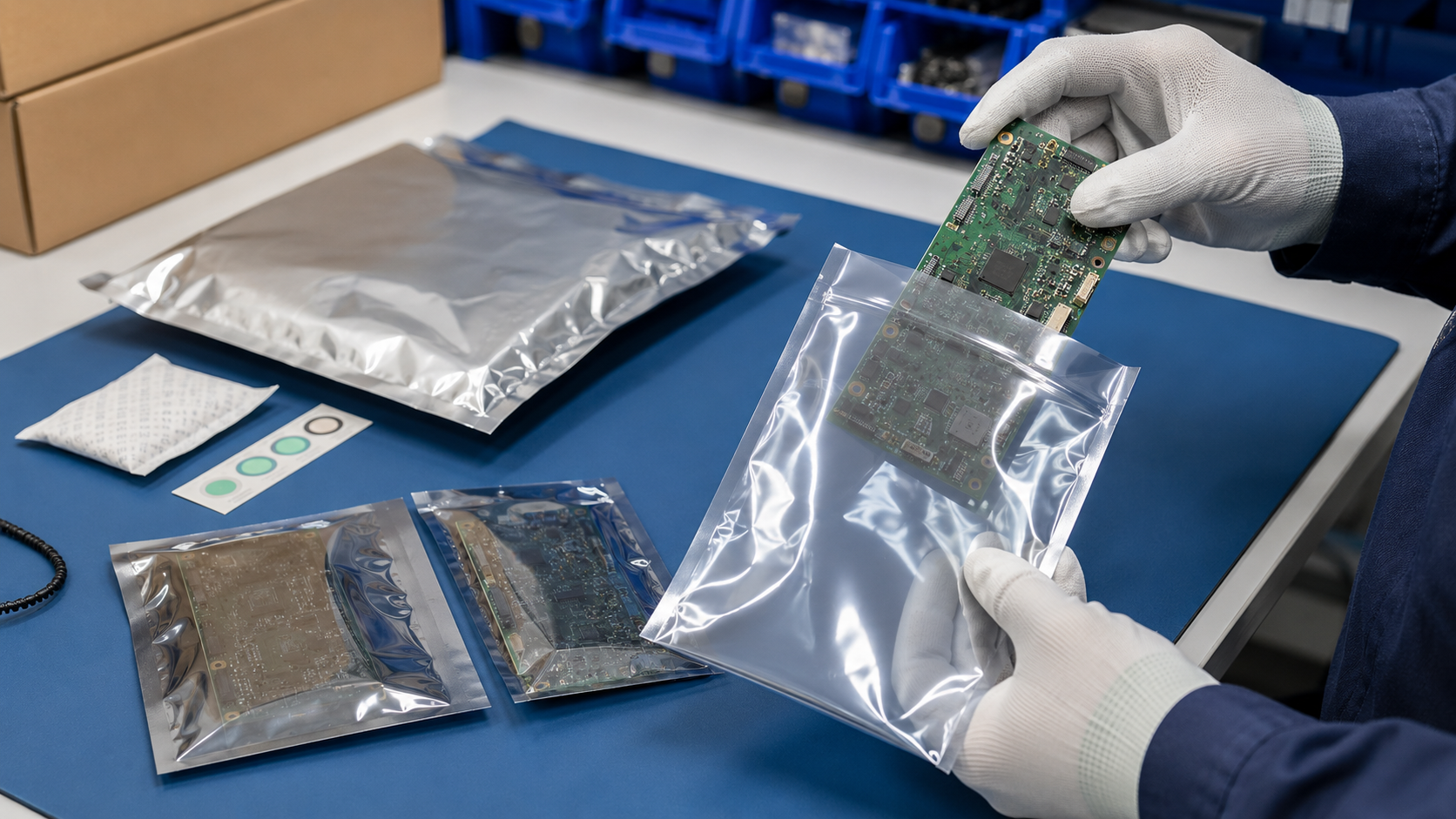
What Are the Three Main Types of ESD Bags?
The phrase ESD bag is often used as a broad label, but bag constructions can perform very different functions. Some materials are designed primarily to reduce charge generation. Others add charge dissipation, discharge shielding, moisture control, or a combination of properties.
Color can help with quick identification, but color alone does not prove electrical performance, shielding capability, moisture protection, or compliance. Always verify the manufacturer’s technical data for the exact material or finished bag being considered.
Mobile table: Swipe left or right to view all columns.
| Bag type | Primary purpose | Discharge shielding | Moisture barrier | Typical starting application |
|---|---|---|---|---|
| Antistatic bag | Reduce charge generation from the packaging material | Not assumed | Not assumed | Non-ESDS items used near sensitive electronics or controlled in-plant applications |
| Static-shielding bag | Low charging, charge dissipation, and protection from discharge energy | Yes, when properly specified and closed | Not unless specifically rated | Circuit boards, ICs, modules, and other ESDS items moving outside an EPA |
| ESD moisture-barrier bag | ESD protection combined with low water-vapor transmission | Verify the specified construction | Yes, when rated for the requirement and properly sealed | Moisture-sensitive devices, dry-pack applications, or controlled storage |
Important: This table is a selection starting point, not a substitute for verified material data, device requirements, customer specifications, or an organization’s ESD control plan.

What Is an Antistatic Bag?
An antistatic bag is designed to be low charging, meaning the bag material helps reduce the generation of electrostatic charge caused by contact and separation. Pink polyethylene is the most familiar example, although antistatic performance is not limited to one color.
The important limitation is that antistatic does not automatically mean discharge shielding. A pink antistatic bag can help prevent the packaging itself from becoming a strong source of triboelectric charge, but it should not automatically be treated as the sole protective package for an exposed ESDS circuit board, semiconductor device, or electronic assembly traveling through an uncontrolled environment.
When antistatic bags may be appropriate
- Packaging non-ESD-sensitive hardware, paperwork, or accessories that will enter an EPA
- Controlled in-plant handling where the complete ESD packaging system has already been defined
- Applications where low charging is required but discharge shielding is not
- Use as one layer within a larger protective packaging system
If the item itself is electrostatic-discharge sensitive and will be shipped outside a controlled area, a properly specified shielding package is generally the more appropriate starting point.
What Is a Static-Shielding Bag?
A static-shielding bag is a multilayer package designed to reduce charge generation, allow controlled charge dissipation, and limit the energy that reaches the packaged item during an external electrostatic discharge. The metallized layer commonly associated with a silver, translucent shielding bag helps create the protective enclosure sometimes described as a Faraday-cage effect.
Shielding performance depends on the complete bag construction and the integrity of the enclosure. The item should be fully contained, and the bag should be closed using the method intended for that design. Punctures, tears, open seams, staples, or sharp component leads can compromise the package.
Common static-shielding bag applications
- Printed circuit boards and populated assemblies
- Integrated circuits and semiconductor components
- Electronic modules, sensors, controllers, and test hardware
- Interfacility transport and shipment outside an EPA
- Applications requiring both product visibility and discharge shielding
When Is an ESD Moisture-Barrier Bag Needed?
An ESD moisture-barrier bag is used when the packaging system must address both electrostatic risk and moisture exposure. These bags use multilayer constructions designed for low water-vapor transmission and are commonly associated with moisture-sensitive semiconductor devices, dry-pack procedures, controlled storage, and demanding transportation environments.
A moisture-barrier bag is only one part of a successful dry package. Depending on the device, process, and governing requirements, the complete system may also include desiccant, a humidity indicator card, moisture-sensitive labeling, controlled handling time, and a validated heat seal.
Consider an ESD moisture-barrier bag when
- The device or assembly is moisture sensitive
- The item will be stored for an extended or controlled period
- The shipment may experience elevated humidity or changing environmental conditions
- The packaging specification calls for a defined moisture-vapor barrier
- The customer’s dry-pack, bake, floor-life, or reflow process requires it
Do not assume that every opaque or foil-looking bag provides the same moisture performance. Confirm the material’s moisture-vapor transmission characteristics, thickness, puncture resistance, sealing parameters, and applicable test data.

Which ESD Bag Constructions Are Available Through Malaster?
Malaster can support substantially more than one general-purpose shielding bag and one moisture-barrier bag. Current supplier data includes standard metal-in shielding, higher-puncture shielding, cleanroom-certified shielding, metal-out corrosion-protection shielding, cushioned shielding, qualified military shielding, and five Dri-Shield moisture-barrier constructions.
This range is why the best bag recommendation begins with the application. Customers can explore Malaster’s ESD bag solutions and then provide the component dimensions, handling environment, moisture requirements, closure preference, and applicable specifications for review. The supplier selection data identifies converting capabilities from approximately 2 inches by 2 inches through 36 inches by 36 inches, along with custom printing and special features. Exact size, closure, construction, minimum quantity, and availability must be confirmed for the selected series.
Static-shielding and specialty shielding options
Mobile table: Swipe left or right to view all columns.
| Supplier family | Primary distinction | Typical construction or thickness | Typical shielding | Typical puncture resistance |
|---|---|---|---|---|
| SCS 1000 Series | Standard transparent metal-in shielding | 2.8 mil polyester, metal, and polyethylene laminate | <10 nJ | 12 lb |
| SCS 1300 Series | Stronger transparent metal-in bag for greater puncture resistance | 3.2 mil polyester, metal, and polyethylene laminate | <10 nJ | 22 lb |
| SCS PCL100 | Certified to IEST-STD-CC1246E Level 100 for surface-particulate concerns | 2.8 mil metal-in laminate | <10 nJ | 12 lb |
| SCS 1250 Series | Metal-out shielding with VpCI corrosion protection for ferrous and non-ferrous metals | 3.0 mil corrosion-protection laminate | <10 nJ | 14 lb |
| SCS 2300R | Cushioned shielding with a closed-cell barrier-bubble layer and tape-top closure | Greater than 0.090 inch total material thickness | <10 nJ | Greater than 20 lb |
| SCS 81705 Series | Qualified to MIL-PRF-81705 Type III, Class 2; standard stock bags converted per MIL-DTL-117 unless otherwise requested | 2.8 mil four-layer laminate with lot traceability | ≤10 nJ | 12 lb |
Typical values are summarized from the supplied manufacturer data. The commercial shielding families state conformance with their listed ANSI/ESD requirements, but they are not automatically qualified military materials. The 81705 Series is the product in this group specifically identified as being on the Qualified Product List.
Dri-Shield moisture-barrier options
All five Dri-Shield families below publish typical ESD shielding below 10 nJ, but their moisture-barrier construction, thickness, reinforcement, and puncture resistance differ materially. The 2000 and 2700 families use aluminized constructions, while the 3000, 3400, and 3700 families use foil barriers and are listed for moisture-sensitive electronics under IPC/JEDEC J-STD-033.
Mobile table: Swipe left or right to view all columns.
| Supplier family | Construction and selection distinction | Thickness | Published MVTR | Typical puncture resistance |
|---|---|---|---|---|
| Dri-Shield 2000 | Aluminized polyester and polyethylene; balanced general moisture and puncture protection | 3.6 mil | <0.035 g/100 in²/24 hr | 20 lb |
| Dri-Shield 2700 | Heavy-gauge aluminized polyester and polyethylene for sharp trays and greater puncture resistance | 7.0 mil | <0.030 g/100 in²/24 hr | 30 lb |
| Dri-Shield 3000 | Nylon, foil, and polyethylene; reinforced foil barrier for moisture-sensitive SMT devices | 6.0 mil | <0.0003 g/100 in²/24 hr | 16 lb |
| Dri-Shield 3400 | Polyester, foil, and polyethylene; thinner foil barrier with greater puncture resistance than 3000 | 4.0 mil | <0.0003 g/100 in²/24 hr | 20 lb |
| Dri-Shield 3700 | High-strength polyester, foil, and polyethylene; strongest published tensile value among the listed foil families | 4.2 mil | <0.0003 g/100 in²/24 hr | 25 lb |
MVTR values are manufacturer-published typical values and are not directly interchangeable without reviewing the referenced test method, conditions, finished-bag configuration, and sealing process. The complete dry package may also require desiccant and a humidity indicator card.
How Does Packaging Change Inside and Outside an EPA?
One of the most useful selection questions is also one of the simplest: Will the exposed ESDS item remain inside an ESD protected area, or will it leave the EPA?
Inside an EPA, packaging and material-handling containers are generally selected to be low charging and conductive or dissipative as required by the organization’s ESD control plan. Outside the EPA, the package must also protect the item from discharge events encountered in uncontrolled handling, storage, and transportation.
The EOS/ESD Association’s packaging guidance explains that packaging used outside an EPA should add discharge shielding. ANSI/ESD S541 defines packaging properties used to protect ESDS items through production, transport, and storage and supports the broader requirements of an ESD control program.
Inside an EPA
Start with low-charging packaging that provides the conductive or dissipative behavior required by the documented ESD control process.
Outside an EPA
Add a properly specified discharge-shielding enclosure for ESDS items, then address moisture and physical protection as required.
Packaging should be treated as one control within the full ESD program. Grounding, handling procedures, personnel controls, equipment, training, verification, and packaging must work together. For a broader explanation, see Malaster’s ESD Fundamentals and Protective Packaging Handbook and ESD Standards and Packaging Compliance Guide.

How to Choose the Right ESD Bag in 7 Steps
Begin with the risk and application, not with bag color or price. The following process helps organize the information needed to select an appropriate bag construction.
-
Identify the item and its sensitivity.
Determine whether the item is an exposed semiconductor, circuit board, electronic assembly, non-sensitive hardware item, moisture-sensitive device, light-sensitive product, or another controlled item. Review device documentation and customer requirements when available. -
Map the complete handling path.
Identify where the item will be loaded, sealed, stored, transported, opened, and removed. Note whether each step occurs inside or outside an EPA and whether the package will be grounded before opening. -
Define the required ESD functions.
Separate low charging, charge dissipation, and discharge shielding into distinct requirements. Avoid treating the general label antistatic as proof that every function is present. -
Evaluate moisture and environmental exposure.
Consider humidity, storage duration, temperature changes, dry-pack requirements, shipping route, cleanliness, corrosion concerns, and exposure to dust or light. -
Address physical protection.
Examine component leads, sharp corners, weight, abrasion points, and the risk of puncturing or creasing the bag. Add compatible cushioning, caps, trays, separators, or rigid outer packaging when needed. -
Choose the size and closure.
Allow enough room for the item and any internal protective materials without stretching the bag. Include the space needed for a zipper, fold, tamper seal, or validated heat-seal area. -
Verify the exact specification.
Review technical data, test methods, thickness, construction, shelf-life information, labeling, traceability, and any applicable customer, industry, or military requirements before approval.
How Should an ESD Bag Be Sized and Closed?
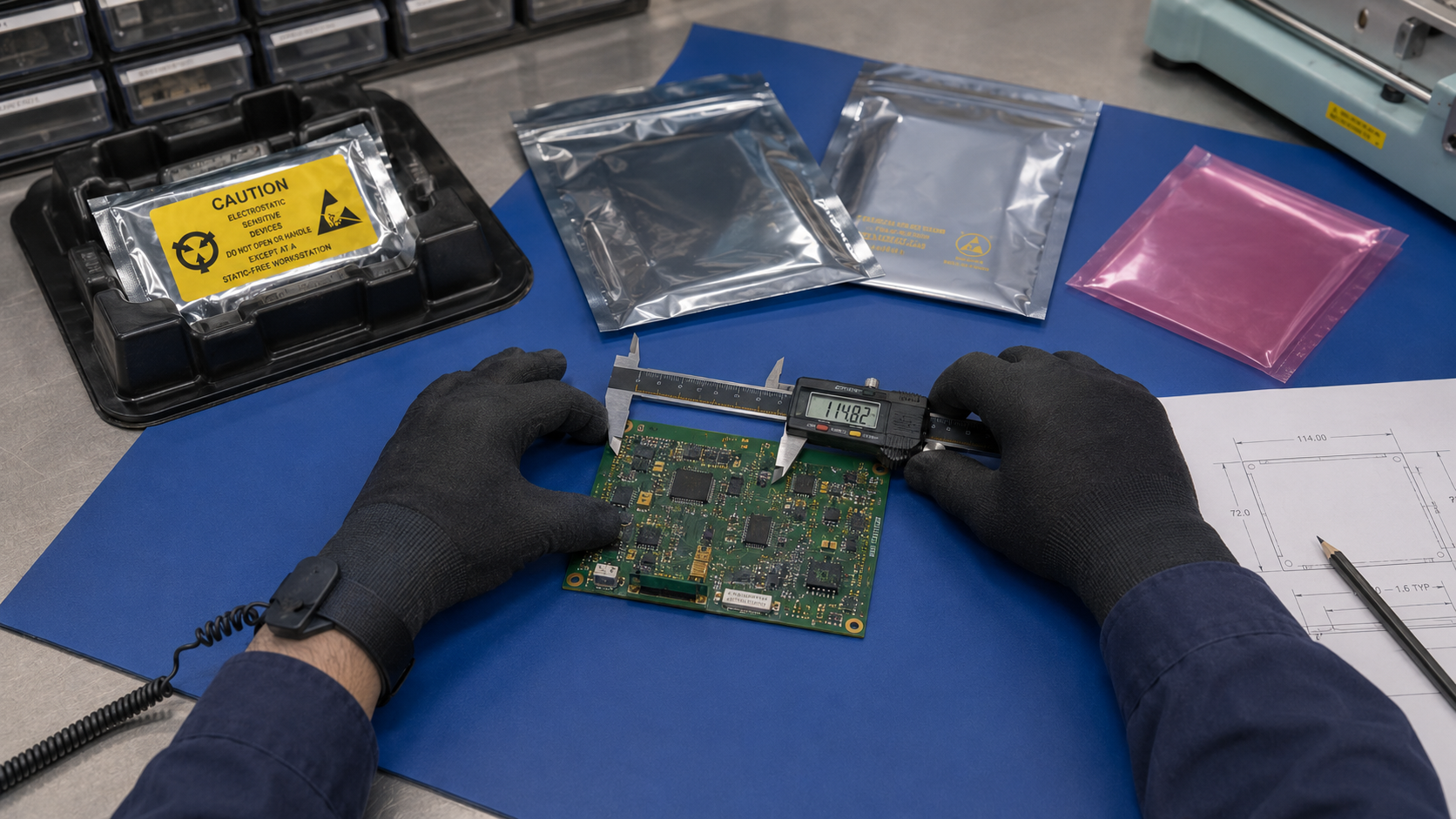
Flat bag dimensions are commonly stated as width by length, but the item’s thickness consumes usable width and length. A bag selected only from the front-face dimensions of a circuit board or assembly may be too tight once component height, edge protection, trays, or cushioning are included.
The bag should allow the item to be inserted and removed without excessive force, stretching, scraping, or placing sharp features against the film. It should also provide enough clear material above the item for the intended closure.
Information needed for bag sizing
- Maximum item width, length, and thickness
- Orientation of the item inside the bag
- Any tray, foam, bubble, separator, or edge protection used inside
- Required clearance for loading and unloading
- Open-top, zipper, fold-over, adhesive, or heat-seal closure
- Vacuum packaging or desiccant requirements
- Labeling, printing, barcode, or traceability area
For complex assemblies, prototypes, or tight packaging, a physical sample or dimensional drawing can prevent a seemingly small sizing error from becoming an expensive production problem.

Common ESD Bag Selection and Use Mistakes
Treating every ESD bag as equivalent
Low-charging, charge-dissipative, discharge-shielding, and moisture-barrier properties describe different functions.
Selecting by color alone
Pink, translucent silver, or opaque foil film may suggest a bag family, but appearance does not verify performance.
Leaving shielding bags open
A shielding material must form a complete protective enclosure using its intended closure method.
Ignoring sharp edges and leads
Pins, solder points, corners, and heavy assemblies can puncture film or damage a metallized layer.
Assuming shielding equals moisture control
A standard shielding bag should not be treated as a moisture barrier unless it is specifically rated for that function.
Skipping specification review
The product label is not a replacement for technical data, process requirements, or customer documentation.

How Malaster Helps Select an ESD Bag
Malaster approaches ESD bags as application-specific packaging rather than a one-size-fits-all commodity. Bag material, shielding behavior, moisture protection, dimensions, closure, thickness, printing, order quantity, and compliance requirements can produce thousands of possible configurations.
Malaster, a California company since 1993, can help organize the requirements, identify an appropriate construction, and obtain standard or custom bag options from established manufacturing sources. Current options extend from 2 mil and 4 mil antistatic reclosable poly bags through standard, high-puncture, cleanroom, corrosion-protection, cushioned, military-qualified, and multiple moisture-barrier constructions. Customers can begin with complete specifications or simply send the information already available.
Need Help Choosing an ESD Bag?
Send your component dimensions, photographs, drawings, packaging environment, quantity, moisture requirements, and any applicable specifications. Malaster will help determine the next practical step.
Frequently Asked Questions About ESD Bags
Are antistatic bags and static-shielding bags the same?
No. Antistatic describes low-charging behavior. A static-shielding bag is designed to add protection from electrostatic discharge energy. A shielding bag may also be low charging, but an antistatic bag should not automatically be assumed to provide shielding.
Can a pink antistatic bag protect a circuit board during shipment?
A pink antistatic bag can reduce charge generation by the packaging material, but it should not automatically be used as the only protective package for an exposed ESDS circuit board traveling outside an EPA. The complete shipping package should provide the discharge shielding and physical protection required by the application.
Does a static-shielding bag also protect against moisture?
Not necessarily. Standard shielding bags are primarily selected for ESD protection. If moisture control is required, use a bag specifically rated for the necessary moisture-barrier performance and follow the applicable dry-pack procedure.
Which Dri-Shield moisture-barrier bag should I choose?
Choose by the required moisture barrier, physical durability, component or tray geometry, dry-pack specification, and sealing process. Dri-Shield 2000 is a balanced aluminized construction, while 2700 increases thickness and puncture resistance. Dri-Shield 3000, 3400, and 3700 use foil barriers for substantially lower published MVTR values, with different reinforcement, thickness, tensile strength, and puncture resistance. The lowest MVTR number is not automatically the only selection factor.
Are all silver ESD bags equivalent?
No. Similar-looking bags can differ in layer construction, metal placement, thickness, shielding performance, durability, cleanliness, closure, and compliance data. Verify the exact product specification.
Are all static-shielding bags MIL-PRF-81705 qualified?
No. A commercial shielding bag may meet its stated ANSI/ESD performance requirements without appearing on the Defense Standardization Program Qualified Product List. Within the current Malaster supplier data, the SCS 81705 Series is specifically identified as qualified to MIL-PRF-81705 Type III, Class 2. Other shielding families should not be represented as qualified military material unless the exact product documentation confirms it.
Which ESD bag is better for sharp trays or components?
Start by identifying whether the package also needs moisture protection or cushioning. The SCS 1300 Series provides greater puncture resistance than the standard 1000 Series for transparent shielding. Dri-Shield 2700 is a heavy-gauge moisture-barrier option developed for sharper trays, while the 2300R combines shielding with a closed-cell barrier-bubble cushion. Edge protection or a rigid tray may still be necessary.
Can ESD bags be reused?
Reuse depends on the bag construction, condition, application, and the organization’s documented ESD control process. Do not reuse a bag with punctures, tears, damaged seams, excessive creasing, contamination, or an unreliable closure. Moisture-barrier and validated dry-pack applications may have additional restrictions.
Do ESD bags have a shelf life?
Shelf-life guidance is product specific. The current supplier sheets for Malaster’s 2 mil and 4 mil antistatic reclosable poly bags list a 12-month shelf life. SCS states that its static-control bags do not have a set life span, but recommends continual inventory replenishment, storage in the original packaging in a dry and ventilated room near 76°F, and protection from sunlight, moisture, and heat. Ripped, torn, or scratched bags should be discarded. A warranty period should not be treated as a universal performance expiration date.
What information does Malaster need to recommend an ESD bag?
Helpful information includes the item description, maximum width, length and thickness, photographs or drawings, ESD and moisture sensitivity, handling environment, storage duration, shipping conditions, closure preference, order quantity, printing requirements, and any customer or industry specifications. Send what you have; missing details can be identified during review.